Denizli Province, Turkey · UNESCO World Heritage since 1988

Pamukkale travel guide: the decisions that shape your visit

Not another gallery of the same photograph. This is the practical stuff: how long to give it, which of the three entrances to use and why it matters, when to arrive, how to get here, and where to sleep. Written by a clinic based twenty minutes down the road, which mostly means we have answered these questions for a lot of visitors.

One full dayTerraces plus Hierapolis
Three entrancesThe choice changes the walk
Apr–Jun · Sep–OctThe comfortable months
Orientation

What Pamukkale actually is

Two things in one place, and most first-time visitors only plan for the first.

The travertine terraces — the "cotton castle"

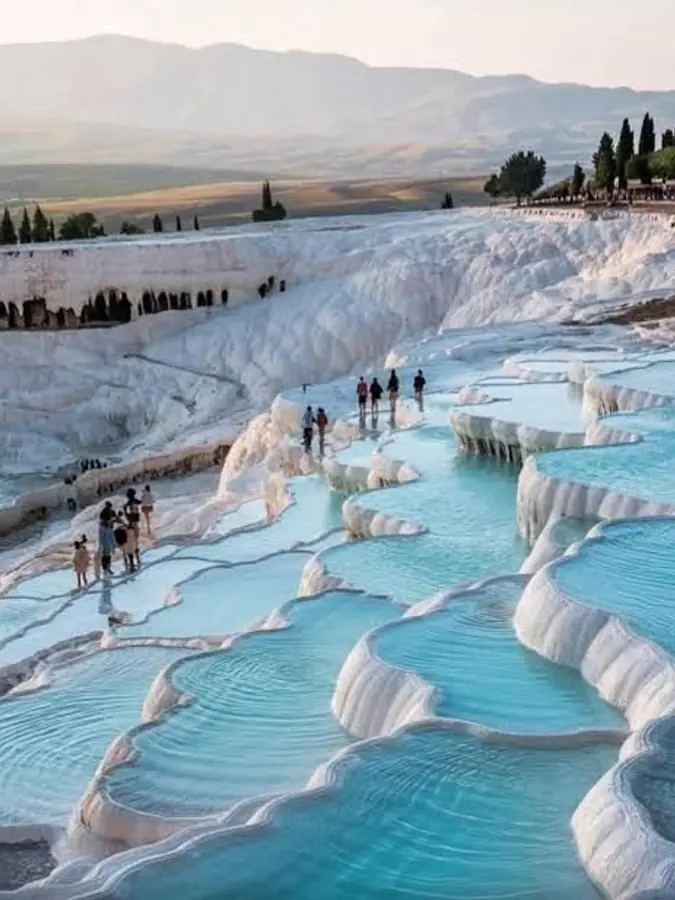
A hillside of white mineral deposit, built up over thousands of years by calcium-rich thermal water flowing down it. Terraced basins hold shallow water where the flow is directed. Pamukkale means cotton castle in Turkish, and from a distance the name makes immediate sense.
Hierapolis — an ancient city on top of it

A Greek and later Roman spa city built above the terraces, with a theatre, colonnaded streets, baths and one of the largest necropolises in Anatolia. The two were inscribed together as a single UNESCO World Heritage Site in 1988. The ruins are extensive and most day-trippers underestimate them badly.

That pairing is the single most useful thing to understand before you arrive. If you budget two hours for "the white pools" you will find yourself at the top of the hill with an entire ancient city in front of you and no time left for it.

The first decision

How many days should you give it?

Half a day

The coach-tour version

What most package day trips from Antalya, Kuşadası or Marmaris deliver, minus four to seven hours in a bus. You will see the terraces and photograph them. You will not see Hierapolis in any meaningful way. It is better than not coming — but it is the version people regret.

One day

The sensible minimum

Terraces and Hierapolis without hurrying, with time to sit down and eat. Arrive early or stay until late afternoon rather than trying to do both. This is enough for most visitors to leave satisfied.

Two days

Where it gets good

You can see the terraces at both sunrise and sunset — completely different experiences — swim properly in the Cleopatra Antique Pool, give the theatre and necropolis real time, and add Laodicea or Karahayıt. An overnight also means you are on the hill before and after the coaches.

Three or more

If you are here for the region

Worth it if you are also using thermal hotels, visiting Denizli itself, or combining the trip with appointments. Beyond three days it becomes a base rather than a destination, which is a perfectly good way to use it.

Our honest recommendation: one night minimum. The difference between a day trip and a single overnight is larger here than almost anywhere else in Turkey, because the two best hours of the day are the two hours the coaches are not here.

The decision nobody explains

Which entrance to use

The site has more than one entrance and they give you genuinely different days. This is the detail most guides skip and the one visitors most often get wrong.

01

Town entrance — at the bottom

In Pamukkale village, at the foot of the terraces. You take your shoes off here and walk up the white hillside. It is the most striking approach and the most effort, uphill and barefoot on uneven mineral. Best if you are staying in the village and have no car.

02

South gate — at the top

Up on the ridge, with parking, close to the ancient city and the antique pool. You start at the top and walk down through the terraces. Easier on the legs, and the usual choice for coach groups — so it is busier when they arrive and empty when they leave.

03

North gate — the far end

Furthest from the terraces, nearest the necropolis and the northern end of the ancient city. Useful if the ruins are your priority, or if you want to walk the length of Hierapolis and come out above the terraces at the end.

The strategy most visitors would choose if they knew

Enter at the south gate, walk through Hierapolis first while you are fresh, then descend the terraces in late afternoon light and exit at the bottom in the village. Arrange to be collected there, or walk back up — note that this is a real climb, so decide before you commit.

Tickets, hours and passes — check before you travel

Entry to the site, the Cleopatra Antique Pool and the archaeology museum are priced separately, and prices and opening hours are revised periodically. We deliberately do not print numbers that would be wrong within a season. Check current official information, or ask your hotel the evening before.

The half people skip

Hierapolis: give it more time than you planned

A spa city, built here because of the springs. If you only have an hour for the ruins, spend it on these.

The theatre

Cut into the hillside and remarkably well preserved, with detailed carving still visible on the stage building. The climb up to it is worth it for the view back over the valley alone.

The necropolis

One of the largest in Anatolia — a long field of tombs of different periods and styles, stretching away from the northern end. Quiet, strange, and usually almost empty.

The colonnaded street

The spine of the ancient city, running the length of the site. Walking it end to end is the easiest way to understand how large Hierapolis actually was.

The Plutonium

A small opening beside the Temple of Apollo where carbon dioxide seeps from the ground — deadly to animals in antiquity, which is precisely why it was treated as a gateway to the underworld. Fenced off now, and more interesting for the story than the sight.

Expectations

About the water — the short version

Visitors walking barefoot down the white travertine terraces at Pamukkale, with shallow water in the basins
The terraces are for walking through, not swimming in — shallow, barefoot, and only partly filled at any given time.

Three things that prevent almost all disappointment:

  • The terrace pools are shallow. Ankle to shin deep in most places. You paddle and walk; you do not swim.
  • Not all of them hold water. Flow is rotated between sections so the travertine can recover, so the basins that are full this month may be dry next month. Nobody can promise you a particular view.
  • Shoes come off. Footwear is not allowed on the travertine. Bring a bag to carry them and expect the surface to be uneven and slippery in places.

If getting properly into warm water matters to you — the Cleopatra Antique Pool, hotel thermal pools, the red springs at Karahayıt — that has its own guide: Pamukkale thermal springs: pools, temperature and access.

Timing

When to visit

By season

April to early June — warm, green valley, comfortable for walking. The best all-round window.
July and August — very hot, very busy, almost no shade on the terraces. Go at opening or near closing if you come now.
September to October — the other good window; still warm, noticeably calmer.
November to March — cold and quiet, and genuinely worth considering. Warm water in cold air beats warm water in hot air. Grey days do mute the colour of the pools.

By hour

At opening — cold underfoot, soft light, very few people. Best for photographs of empty terraces.
Late morning to mid-afternoon — the coach window. Busiest and harshest light.
Late afternoon to closing — the water is at its warmest, the light turns gold, and the groups have gone. If you can only pick one, pick this.

Logistics

How to get to Pamukkale

Approximate road distances and times — treat them as planning figures, not timetables.

DNZ

Denizli Çardak Airport

The closest airport, roughly 65 km away, about an hour by road. Fewest flights, but the shortest transfer by a wide margin. Check the schedule before assuming it works — routes here are seasonal.

ADB

İzmir Adnan Menderes

Around 250 km, roughly three hours by road. Far more flights and far more choice, and it lets you add the Aegean coast to the trip. The most common route for international visitors.

Denizli

From the city centre

About 19 km, a 20 to 25 minute drive. Frequent minibuses run from the Denizli bus terminal to Pamukkale village throughout the day, and the intercity bus network makes Denizli easy to reach from most of Turkey.

Road

Antalya and Istanbul

Both are long drives — Antalya several hours over mountain roads, Istanbul most of a day. Day trips from the coast exist and are legitimately exhausting. If you are coming from either, flying into Denizli or İzmir is usually the better call.

Where to base yourself

Pamukkale village, Karahayıt or Denizli?

Three genuinely different choices. We do not sell accommodation and have no stake in which you pick.

01

Pamukkale village

At the foot of the terraces. Small, walkable, mostly guesthouses and small hotels. The reason to stay here is being able to walk to the entrance at opening time. Quiet in the evening, limited choice for dinner.

02

Karahayıt

A few kilometres north, where most of the larger thermal hotels are. Choose this if soaking in thermal water is a main goal rather than a bonus. Less atmospheric than the village, more facilities.

03

Denizli city

Twenty to twenty-five minutes away. A real working city — the widest choice of restaurants, shops and transport connections, and the practical base if you are combining the trip with appointments or onward travel. You trade morning proximity for everything else.

On food: Denizli is the place to eat properly. The village and Karahayıt are geared to visitors and hotel half-board; the city is where the local cooking actually is.

If you have a second day

Worth adding nearby

Laodicea

A large ancient city a short drive away, under active excavation and far quieter than Hierapolis. Rewarding if ruins interest you; skip it if they do not.

Kaklık Cave

Sometimes described as an underground Pamukkale — travertine formations inside a cave, on a much smaller scale. A short, easy stop rather than a half day.

Sunrise from the air

Balloon flights and paragliding both operate over the valley in season. We do not run them and cannot vouch for any operator — check licensing and insurance yourself before booking anything that leaves the ground.

If your trip is also an opportunity to take care of something health-related, that is a separate conversation and we have written it up separately: combining treatment with a stay in Pamukkale.

Frequently asked

Questions visitors ask before coming

How many days should I spend in Pamukkale?

One full day covers the terraces and Hierapolis without rushing. Two days lets you add the Cleopatra Antique Pool properly, see the terraces at both sunrise and sunset, and visit Laodicea or Karahayıt. Most people who come for a half day on a coach tour from the coast leave wishing they had given it longer.

Which entrance should I use?

The town entrance at the bottom means walking up barefoot — harder work, most memorable approach. The south gate puts you at the top near the ancient city, so you walk down through the terraces; easier, and the usual coach choice. The north gate is furthest from the terraces and closest to the necropolis. With a car and a preference for less effort: south gate, walk down.

What is the best time of year?

April to early June and September to October are the most comfortable. July and August are very hot with little shade. Winter is quiet and can be excellent — warm water in cold air is a better experience than warm water in hot air — though overcast days flatten the colour of the pools.

How do I get there?

Denizli Çardak Airport (DNZ) is closest, roughly 65 km, about an hour by road. İzmir Adnan Menderes (ADB) is around 250 km, roughly three hours, with far more flights. From Denizli city centre it is about 19 km, a 20 to 25 minute drive, with frequent minibuses from the bus terminal. Antalya and Istanbul are both long road journeys.

Is Pamukkale worth visiting?

Yes, with one adjustment to expectations: the terraces are shallow and only some sections hold water at a time, because flow is rotated to protect the travertine. Visitors who arrive expecting to swim in turquoise basins are the ones who leave disappointed. Visitors who come for the walk down a white hillside above an ancient city rarely are.

Where should I stay?

Pamukkale village is closest and best for an early start. Karahayıt has most of the larger thermal hotels and is quieter. Denizli city is 20 to 25 minutes away with the widest choice of restaurants and transport, and suits anyone combining the trip with appointments or onward travel.

Can I visit Pamukkale as a day trip from Antalya or Kuşadası?

You can, and thousands of people do. Expect four to seven hours on a bus for a few hours on site, most of it spent on the terraces rather than in Hierapolis. It works if it is your only option. If you can manage one overnight instead, the difference is substantial.

About this page

Written by Dr Otgen Clinic, a medical clinic in Denizli, about twenty minutes from the travertines. We are not a tour operator and do not sell tours, tickets or accommodation. Last content update: .

Distances and journey times are approximate planning figures. Ticket prices, opening hours and gate arrangements change — check current official information before you travel. Background on the site: UNESCO World Heritage Centre — Hierapolis-Pamukkale. This reference is not a statement of accreditation or affiliation.