Dissolved rock, carried upward
Groundwater moves through limestone underground, warming as it goes and dissolving calcium bicarbonate on the way. It emerges at the top of the ridge above the modern village.
Most guides show you the photograph and stop there. This one answers the questions people actually arrive with: which pools hold water, how warm it really is, what the rules are, where to swim properly — and whether any of the healing claims you have read are true.
Understanding this takes two minutes and changes how the place looks when you are standing on it.
Groundwater moves through limestone underground, warming as it goes and dissolving calcium bicarbonate on the way. It emerges at the top of the ridge above the modern village.
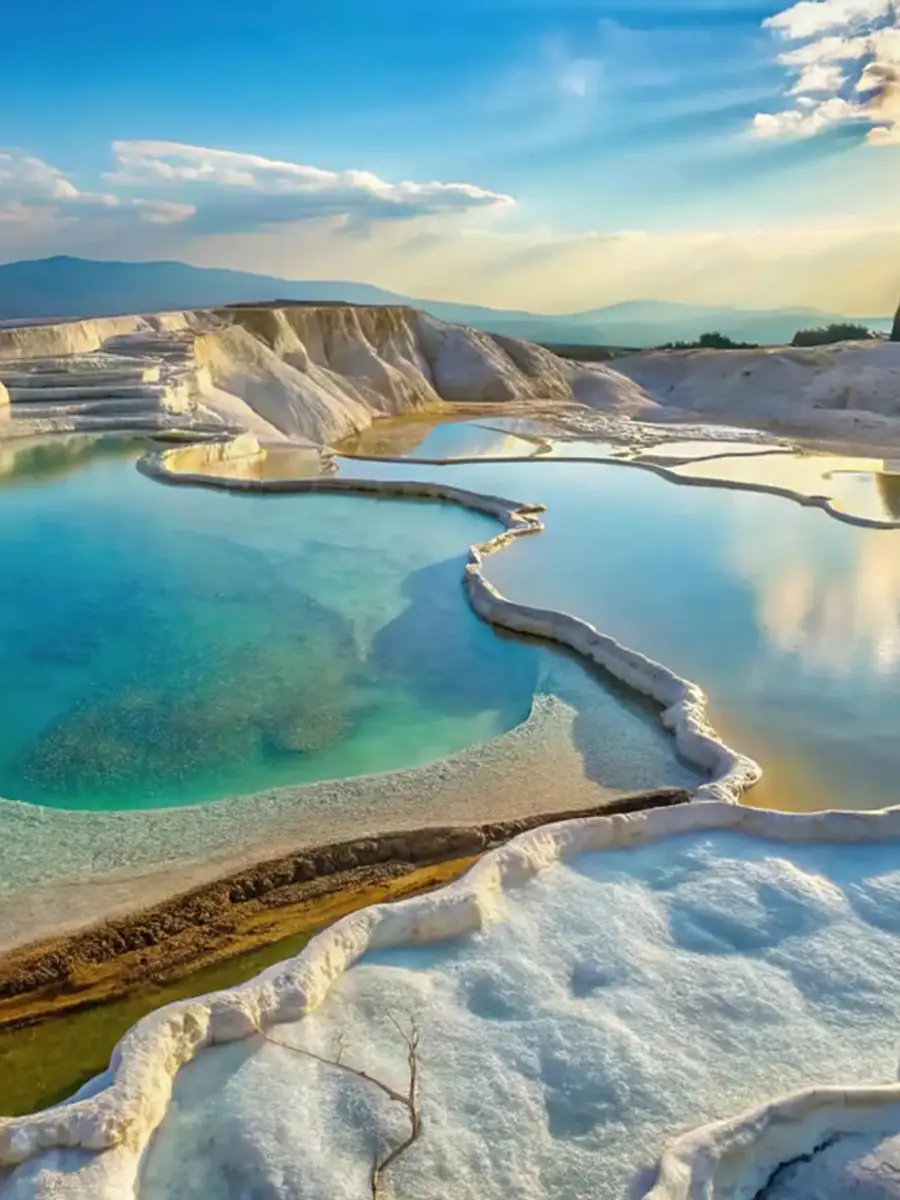
At the surface, carbon dioxide escapes from the water. That shifts the chemistry, calcium carbonate drops out of solution, and a thin layer of white mineral is left behind wherever the water flows.
The terraces are that deposit, layer upon layer, shaped by where the water happened to run. It is still forming today, which is exactly why where you may walk is controlled.
New to the site as a whole? Start with our Pamukkale travel guide — how long to stay, which entrance to use and how to get here.
Two consequences worth knowing before you arrive. First, the white surface is a living deposit, not polished stone — it is uneven, sometimes chalky, sometimes slick. Second, the flow across the terraces is managed: water is directed to different sections at different times so the travertine can recover. That is why photographs from one month show full turquoise basins and the next month shows dry white bowls, and why nobody can promise you which pools will be filled on your day.
There are three different answers, and mixing them up is the most common reason people leave disappointed.
You can walk barefoot along the designated route and stand in the basins that are filled. They are shallow: ankle to shin in most places. It is lovely and it is not a swim. Do not plan your day around lying in a turquoise basin — plan it around walking down through them.
Inside the Hierapolis site, with a separate entry fee on top of the site ticket. Deep enough to swim, fed warm, and with ancient masonry lying on the bottom. This is the one to plan for if being in the water matters to you.
Hotels in Pamukkale village and especially in Karahayıt run their own thermal pools. Less spectacular, far less crowded, and you can stay in as long as you like. If your priority is soaking rather than sightseeing, this is where it actually happens.

You are swimming over fallen columns and cut stone from the ancient city, in warm mineral water, in the open air. There are not many places on earth where that sentence is literally true. The water is clear enough to see the masonry under you, and it stays warm when the terraces have gone cool.
It is a managed attraction, not a secret spring: paid entry, changing rooms, lockers, a time limit at busy periods, and a lot of other people in high season. Come early or late if you want room to move. The name is a marketing name — there is no evidence Cleopatra swam here.
Worth it? If you want to say you swam in it, yes, and the sensation of the warm water over old stone is real. If you mainly want quiet warm water for an hour, a hotel thermal pool will give you more of that for less money and no queue.
Short version below; the full Karahayıt guide covers day passes, timing and how it compares with Pamukkale.
A few kilometres north of Pamukkale, and almost entirely absent from the itineraries that bus people in and out in three hours.
The springs at Karahayıt carry more iron than those at Pamukkale. Where the water runs, the deposits are stained rust red, orange and ochre instead of white. It is a smaller, scruffier, more workaday place — a village with thermal hotels rather than a world heritage panorama — and that is precisely its appeal if you have already walked the terraces with three hundred other people.
Anyone staying more than one night, anyone travelling out of season, and anyone whose real goal was warm water rather than photographs.
If you have one day and have not yet seen Hierapolis, spend it up on the ridge instead. Karahayıt rewards time you have, not time you are borrowing.
It is a short drive or a local bus ride from Pamukkale village. Most thermal hotels there have day passes for their pools — worth asking rather than assuming.
Footwear is not permitted on the travertine. Bring a bag you can carry them in — you will be walking a fair distance barefoot, and you will not want to be holding them.
Chalky and rough in places, slippery where water runs. Take it slowly. If you have balance or mobility concerns, this is the detail nobody mentions and the one that matters most.
Even if you only intend to paddle, you will get wet to the knee. If you plan on the antique pool, bring swimwear — you will not enjoy improvising.
White mineral reflects hard. Hat, sunglasses and sunscreen from spring through autumn; there is very little shade on the terraces themselves.
The open terraces are a protected surface and access is restricted to designated sections. It is also the only way the place survives being this popular.
The site has more than one entrance, the Cleopatra Antique Pool charges separately from the main ticket, and prices and opening hours are revised periodically. We deliberately do not print numbers here that would be wrong within a season. Check the current official information, or ask your hotel the day before.
The terraces alone take about an hour and a half at an unhurried pace. Add Hierapolis and you are at half a day. Add the antique pool and a meal and you have filled a full one.
Early morning is cool and quiet — beautiful, but the water has not warmed and the terraces can feel cold underfoot. Late afternoon into sunset is the sweet spot: warmest water, best light, and the coach groups have gone. Midday in summer is the one to avoid — hot, crowded and harshly lit.
April to early June and September to October are the comfortable months. July and August are very hot and very busy. Winter is genuinely worth considering: far fewer people, and warm water in cold air is a better experience than warm water in hot air — though grey days do flatten the colour of the pools.
You will read, around Pamukkale and in a great deal of travel writing about it, that the water heals: that it treats skin conditions, helps rheumatic complaints, improves circulation, is good for the eyes. The claims are old and they are repeated confidently.
Here is the position we can defend as a medical clinic: bathing in thermal water is not a treatment for any medical condition. What warm water reliably does is help people relax — and rest genuinely matters. That is an honest claim. "Healing waters" is not.
The history is real, and it is more interesting than the marketing. The Greeks and Romans built a spa city here — Hierapolis — precisely because they believed the springs restored people. They were not being cynical; they were working with the medicine they had. Reading that history as history is rewarding. Reading it as a prescription is not.
There is a practical reason to care about this beyond accuracy. If a hotel, tour or clinic tells you that bathing will treat a disease, you have learned something about how carefully that provider makes claims in general — and it is reasonable to weigh everything else they tell you accordingly.
Ask your own doctor before bathing, particularly if you have open wounds, an active skin condition, or are immunosuppressed. Warm shared water is not risk-free, and "natural" does not mean "harmless".
That is a different question from bathing, and it has a different answer. We wrote about the distinction between a spa visit and a medically supervised assessment — including where thermal water does and does not belong.
Medical wellness and spa: the difference →You can walk and paddle in the designated terrace pools that hold water, barefoot, but they are shallow — ankle to shin deep in most places. For an actual swim you need the Cleopatra Antique Pool inside the site, which charges a separate entry fee, or a thermal hotel pool in Pamukkale village or Karahayıt. Which terrace pools are filled changes, because the water is rotated to protect the travertine.
Warm rather than hot. At the source it is typically cited in the mid-30s Celsius, and by the time it has spread across open terraces it is cooler — noticeably so on a windy day or early in the morning. The Cleopatra Antique Pool, fed more directly, stays warmer and more consistent.
The spring water is rich in dissolved calcium bicarbonate. As it reaches the surface and carbon dioxide escapes, calcium carbonate precipitates out and hardens into travertine. The terraces are that deposit, built up over thousands of years. The process is still going on, which is why access is managed.
Yes. Shoes are not allowed on the travertine, to protect the surface. Bring a bag for them. The travertine is uneven and can be slippery where water runs over it, so walk slowly and expect it to feel rough underfoot.
Bathing in warm mineral water has a long cultural history here and many people find it relaxing, which has real value. It is not a treatment for any medical condition, and claims that it cures skin disease, rheumatic complaints or circulatory problems are not supported. If you have a skin condition, open wounds or a weakened immune system, ask your own doctor before bathing.
Karahayıt is a village a few kilometres north with its own springs. The water there carries more iron, which stains the deposits red and orange rather than white. It is smaller and less dramatic than the main terraces, but it is where many thermal hotels are, and it is far quieter.
Sections of them, often. Flow is directed to different areas at different times so the travertine can recover, so the basins that are full today may be empty next month. Nobody can promise you a particular view — which is a good reason not to build your whole trip around one photograph.
Written by Dr Otgen Clinic, a medical clinic based in Denizli, about twenty minutes from the travertines. Last content update: .
Ticket prices, opening hours and gate arrangements change; check current official information before you travel. Background on the site: UNESCO World Heritage Centre — Hierapolis-Pamukkale. This reference is not a statement of accreditation or affiliation.